People ask whether artificial intelligence can replace the astrologer’s chair or whether it is simply another quick way to get chart language.
The short answer is layered: AI can deliver accurate data, pattern recognition, and immediate transit context, but translating that into psychologically intelligent, strategic guidance still needs human nuance and ethical judgment. This piece maps what AI currently does well, where it falls short, and how to use both tools together to make clearer decisions during transitions and timing windows.

What AI reliably offers
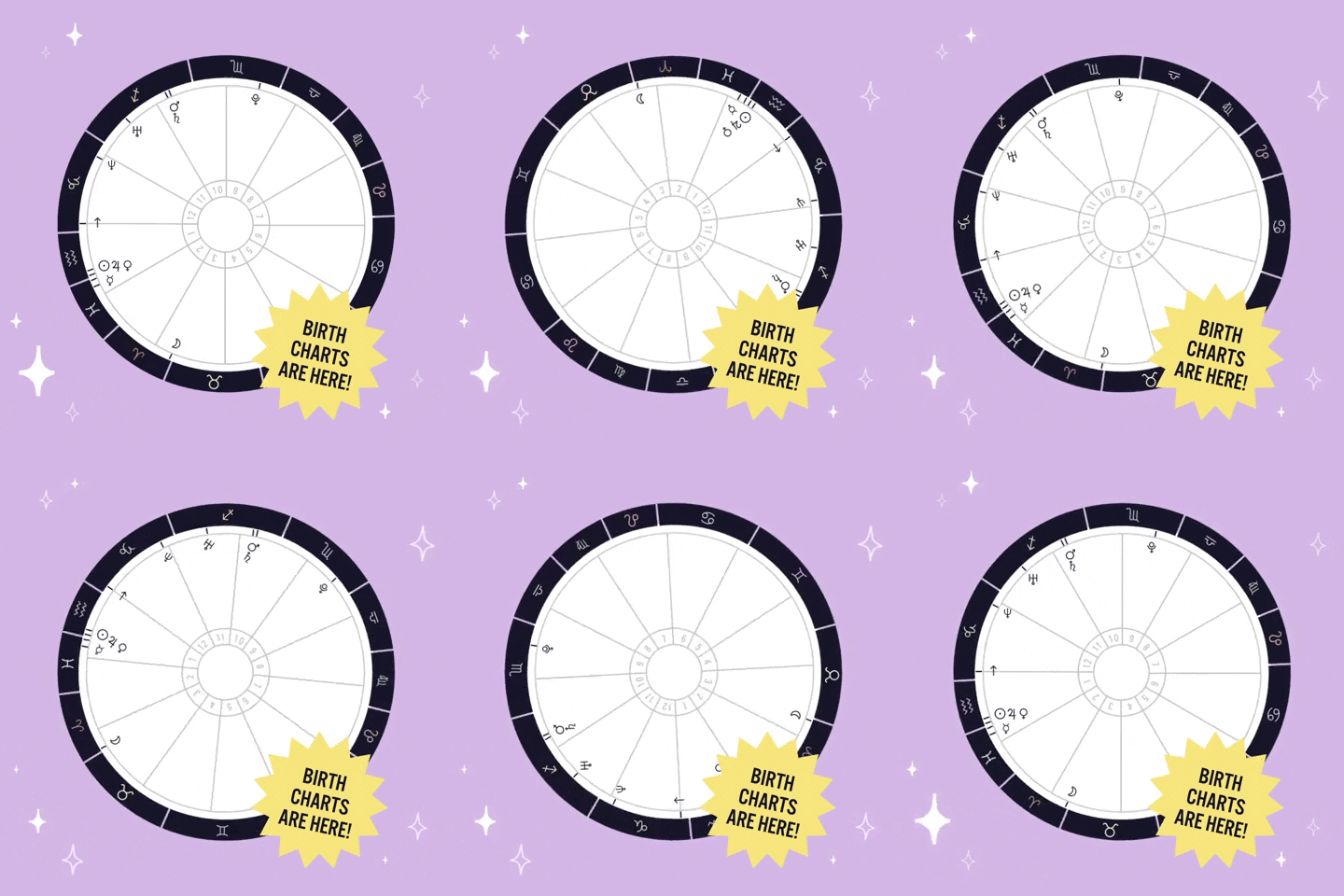
AI excels at technical tasks that are rule-based and data-heavy. It will calculate planetary positions, rising sign, house placements, aspects, and transit overlays instantly and without arithmetic error. For readers who want fast, consistent chart facts and transit timing, AI provides a dependable baseline you can consult 24/7. When prompts ask for summaries of planetary placements or a list of upcoming transits, AI is efficient and consistent, and that reliability makes it a useful part of a practical astrology workflow.
Where AI shows real promise
Pattern recognition and synthesis across large datasets is AI’s strength, which means it can surface correlations and historical transit patterns that a single practitioner might miss. AI can efficiently compare your current transit map to earlier cycles, flag repeating themes, and generate timelines that support strategic planning for career moves, relationship decisions, or major deadlines. That kind of comparative, timing-focused output fits Astrology SA’s emphasis on astrology as a practical decision-making tool.
Where AI still needs human judgement
AI can list placements and describe archetypal energies, but psychological subtlety is different. Translating a Saturn return’s structural pressure into a humane, context-sensitive plan requires empathy, prioritization, and an appreciation of the client’s values—areas where a skilled astrologer excels. Ethical decisions—when to highlight risk, when to slow someone down, how to frame sensitive timing—also call for human oversight and clinical instincts that AI tools do not have by themselves.
Common AI pitfalls in chart reading
- Overgeneralization: AI tends to rely on template language and can default to stock phrases that feel generic rather than tailored to a person’s story.
- Missing contextual nuance: Birth-time uncertainty, rectification choices, and culturally specific expressions of archetypes are easy to miss without an interviewer’s clarifying questions.
- False precision: A confident-sounding interpretation that lacks grounding in the client’s lived reality can mislead readers into false certainty.

How to ask AI better questions
If you decide to use an AI tool, the difference between vague and strategic output is your prompt. Ask for specifics, for example: “Compare my natal Mars-Saturn pattern to the current Mars transit; recommend three practical actions for career friction.” That structure forces the model to pair technical detail with a recommended course of action, which is the point of applied astrology. Aim prompts at timing (dates and windows), relationships (communication patterns, power dynamics), and sensation (how energy shows up in daily life) to get usable advice.
Integrating AI with human practice
Treat AI as a research assistant rather than a substitute. Use AI to generate timelines, list recurring transits, and draft initial phrasing; then apply human editing to add psychological depth, ethical context, and prioritization. For readers who want a faster way to test their questions before booking a full reading, AI is a responsible triage tool when its limits are acknowledged.
A closer look: transits, retrogrades, and nuance
Current astrological conversations emphasize the interpretive weight of slow-moving outer planets and eclipses when advising on life-shaping decisions. AI can flag when a natal moon is being triggered by Pluto or when a natal Sun meets an eclipse point, but deciding whether that transit requires immediate action or reflective containment depends on the client’s capacity and context. Use AI-provided transit flags as conversation starters; then let a human astrologer assess urgency, resilience, and timing strategy.
Practical takeaways you can use now
- Use AI for accurate, fast transit checks and to create a timeline of repeating cycles.
- Ask AI for concrete, short-term actions tied to transit windows (for example, three things to do during a Mercury retrograde) and then refine those actions with a human advisor.
- Keep records: save AI-generated timelines and compare them with lived outcomes to learn how a particular AI tool’s language matches your experience.
- Treat AI advice as provisional: verify major calls, like financial or medical decisions, with human professionals.

Signal: AI for instant, action-focused astrology
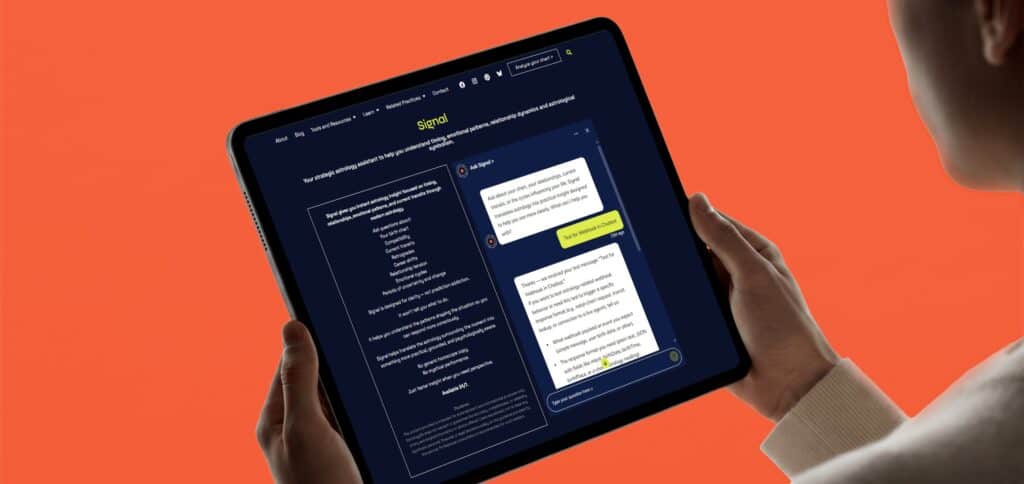
Signal is Astrology SA’s AI assistant built to offer instant astrology insight aligned with practical timing, relationships, and emotional patterns. It’s positioned as a 24/7 resource for readers who want immediate, applied guidance that respects the platform’s emphasis on clarity and strategy. For pragmatic seekers who want a quick, actionable reading to orient themselves before deeper work, Signal functions as a low-friction first step.
How to use Signal well
- Be specific: include birth time, location, and the decision or area you want to focus on to get targeted output.
- Use it for timing: ask Signal about windows for starting projects, relationship conversations, or career pitches so you have concrete dates to test.
- Use it as preparation: get an instant read from Signal before a paid consultation so you arrive with sharper questions and clearer priorities.
When to choose a human reading instead:
If the issue involves trauma, mental health, legal or medical decisions, or complex relationship mediation, choose a human astrologer who can hold nuance and ethical responsibility. Use AI for orientation and logistics, then move to a human practitioner for interpretation that requires therapeutic sensitivity and sustained follow-up.
Example prompt to get a useful AI answer
Try a prompt such as: “My natal Sun in Virgo conjunct Mercury in the 10th house; upcoming Saturn transit squares my natal Sun in June 2026—list three strategic steps to protect my professional reputation and one question I should bring to a human astrologer.” That kind of prompt yields tactical suggestions and highlights where human perspective is needed.
Closing thought
AI is a tool for scaling clarity and speed, not a shortcut past depth. When used thoughtfully, AI can sharpen timing, surface patterns, and accelerate practical planning; when used without discernment, it risks turning richly textured charts into blunt advice. Pairing AI outputs with human judgment keeps astrology both precise and humane, which aligns with how Astrology SA frames the craft as a tool for decision-making, timing, and personal growth.
FAQ
Can AI really explain a birth chart?
AI can explain the technical basics of a birth chart, including planetary placements, aspects, and transits, but it usually does better at pattern recognition than deep interpretation. For nuanced birth chart reading, especially around timing, relationships, and emotional patterns, human judgment still matters.
What is the best way to use AI for astrology?
The best use of AI in astrology is as a fast, practical assistant for chart data, transit timing, and initial insight. It works well when you want instant answers, but it should be used alongside your own reflection or a skilled astrologer for more complex questions.
Is AI astrology accurate?
AI astrology can be accurate when it comes to calculations, natal chart placements, and basic transit information. Where it becomes less reliable is in the interpretation, since astrology depends on context, nuance, and lived experience.
Can AI give me a personalized birth chart reading?
AI can generate a personalized birth chart reading if you provide accurate birth data and a clear question. However, the reading is usually most useful as a starting point for reflection rather than a final answer.
What can AI tell me about my current transits?
AI can quickly identify your current transits and explain the general themes they may activate in areas like career, relationships, and emotional growth. It is especially useful for timing questions and spotting recurring patterns in your chart.
Should I use AI instead of a human astrologer?
AI is helpful for instant astrology insight, but it is not a complete replacement for a human astrologer. If your question involves major life decisions, sensitive relationship dynamics, or deeper psychological work, a human reading will usually offer more depth.
How can I ask better astrology questions to AI?
Ask specific questions that include your birth details, your current situation, and the kind of guidance you want. Questions about timing, relationship patterns, and practical next steps usually produce the most useful AI astrology answers.
What is Signal from Astrology SA?
Signal is Astrology SA’s AI assistant designed to give instant astrology insight focused on timing, relationships, emotional patterns, and current transits. It is meant to be a 24/7 tool for readers who want quick, modern, and practical astrology guidance.