
Most of us were handed a zodiac sign in childhood and never asked a very basic question: which zodiac?
It sounds like a technicality. For anyone trying to understand why their career stalled at 34, took off at 41, or suddenly feels wrong at 52, it is anything but. Career timing is the most practical question we bring to astrology, and it depends on one thing above all else: whether the chart you are reading is actually describing you.
That is where Mastering the Zodiac (MTZ) comes in, and why I think it deserves more attention than it gets. We will get to it. First, let’s talk about how a birth chart explains career timing at all, and why 2026 has been such a loaded year to ask the question.

Two zodiacs, one very important difference
Most Western astrology you will read online uses the tropical zodiac, which is anchored to the seasons: 0° Aries begins at the spring equinox. The sidereal zodiac is anchored to the fixed stars. Because of the slow wobble of Earth’s axis (precession), the two have drifted apart by roughly 24 degrees.
In practice, that means a planet that is “early Aries” in a tropical chart can sit in the previous sign in a sidereal one. Many people discover that their Sun, Moon or rising sign is different in the sidereal system. For career work, where we care about the exact sign and house a planet occupies, that shift can change the whole story.
MTZ offers what it calls a true sidereal report. If you have ever felt that your tropical sign described someone slightly adjacent to you, this is the experiment worth running.
How a birth chart actually shows career timing
A chart is not a job description. It is a map of capacities and a calendar of when those capacities get activated. Here is what I look at first.
The Midheaven and the 10th house. The Midheaven (MC) describes your public role: how you want to be seen, what you build in the world. The sign on the 10th house and the condition of its ruler show the style of your work. Ask what planet rules that sign, where it sits, and what it is connected to.
The 6th and 2nd houses. The 6th is daily work, routines and service. The 2nd is income and what you value enough to charge for. A chart with a strong 10th but a stressed 6th often describes someone with big vision who burns out on daily execution. The reverse describes the brilliant operator who underestimates their public potential.
Saturn. Saturn is the career planet in the classical sense: responsibility, mastery, the slow earning of authority. Its first return (around ages 28 to 30) and second return (around 58 to 60) are the great professional audits of a lifetime. Saturn’s squares and oppositions to its natal position, roughly every seven years, are the checkpoints in between.
Jupiter. Jupiter cycles through the chart about every 12 years. Where it transits is where doors tend to open, but only if you have done the Saturn work first. Jupiter rewards readiness more than hope.
Eclipses and the nodes. Eclipses that touch your angles or your 10th, 6th or 2nd house rulers tend to mark endings and beginnings you did not entirely plan. They are less like lightning and more like a landslide that reveals the real terrain.
Time-lord techniques. Many astrologers add progressions, solar returns and annual profections. These move the question from “what is my potential?” to “which part of my chart is switched on this year?” That is the question career decisions really hinge on.

Why 2026 has been such a loaded year for work
The headline transits of 2026 are widely discussed in the tropical zodiac, so I will name them that way, then explain why your own chart changes the meaning.
Saturn and Neptune at the start of Aries. Saturn entered Aries in February 2026, and Saturn and Neptune met at 0° Aries within days of each other. Saturn builds structure; Neptune dissolves it. Together they asked a generation of workers: what are you building, and is it still worth building? Many people found that a role, a business model or an identity that had felt solid quietly lost its meaning. That is not failure. It is Neptune dissolving what Saturn was about to cement into place for the next two-plus years.
Uranus settling into Gemini. Uranus returned to Gemini in late April 2026 and will stay for years. Gemini governs communication, information, learning, and the way we trade ideas. Think shifting norms around AI tools, remote and hybrid work, freelance models, and how credentials are valued. For some, that is liberating. For others, it is the floor moving.
Jupiter in Cancer, then Leo. Jupiter finished its Cancer stay at the end of June and entered Leo, where it remains into 2027. The first half of the year favored work rooted in security, care, home and belonging. The second half has asked for visibility, creative risk and leadership. People who cannot find their voice at work will feel the Leo Jupiter as pressure; those who are ready feel it as permission.
Eclipses in the Leo and Virgo axes. The 2026 eclipse series touched the Aquarius/Leo and Virgo/Pisces axes, which is the territory of recognition versus community, and service versus surrender. Those are precisely the tensions many professionals are sitting inside.
None of this lands the same for any two people. A tropical “Saturn in Aries” falls in a different house in each chart. And if your planets sit in different signs in the sidereal zodiac, the picture can look different again. The sign, house and angle a transit touches decides whether it feels like a promotion, a pivot or a pause.
Three examples of the same transit, different careers
Example 1: The mid-career manager. Dana’s Midheaven is in a mutable sign and her natal Saturn sits in the 6th house. Saturn’s pressure on her daily work did not arrive as a demotion. It arrived as a refusal to keep absorbing other people’s workloads. The right move was not a new job; it was a restructure of her role. The timing was the chart’s way of saying: boundaries now, ambition after.
Example 2: The consultant at 50. Marcus has a strong 3rd-house emphasis (communication, teaching, writing) and Uranus is now moving through that part of his chart. He is being pushed to rethink how he delivers expertise. His career is not ending; it is being repackaged. Astrologically, he is a prime candidate for a Jupiter-supported launch once the Uranus experiments settle.
Example 3: The returner. Priya paused her career for caregiving and has been circling a return for two years. Her chart shows Jupiter approaching her 10th house ruler and an eclipse touching her 2nd. Her timing question is less “should I?” and more “which of the next three windows is best?” A birth chart, read well, can narrow that.
These are composites, not clients, but they illustrate the principle: a transit is only meaningful once you know where it lands in your chart.
Why this matters now
We are in a stretch where the old career script is under pressure. Structures are being tested (Saturn), ideals are being dissolved (Neptune), and the rules of communication and work are being rewritten (Uranus). In moments like this, generic horoscopes are not enough. “Aries season is a great time to start something” is not useful to someone whose chart shows the 8th house under pressure and the 10th house resting.
Personalized charts matter more precisely when the collective weather is intense. They help you separate what is happening to everyone from what is happening to you.

Where Mastering the Zodiac fits in
This is the part where I recommend something, so let me be specific about why.
MTZ is built around a true sidereal approach. You enter your birth details, and the system generates a report based on your own chart. Two things stand out to me for anyone asking career-timing questions.
1. The true sidereal report. If your career story has never quite matched the sign you were taught to read, seeing your placements in the sidereal zodiac can be a genuine reorientation. Some readers find their Sun, Moon or rising sign changes. Others find the same sign but a very different degree and emphasis. Either way, you are working from a chart anchored to the stars rather than the seasons, which is a legitimate and ancient way of reading the sky that many Western readers never encounter.
2. The more in-depth yearly report. A foundational chart tells you who you are. A yearly report asks what the year is doing with it. For career timing, that is the more useful lens: which areas are being activated, which are quiet, and where to place your energy. If you want a fuller picture of the year ahead, MTZ’s in-depth yearly report is designed to go further than the basic report.
I like that MTZ is positioned as a practical self-knowledge tool rather than a prediction machine. It does not tell you what to do. It gives you better questions to ask.
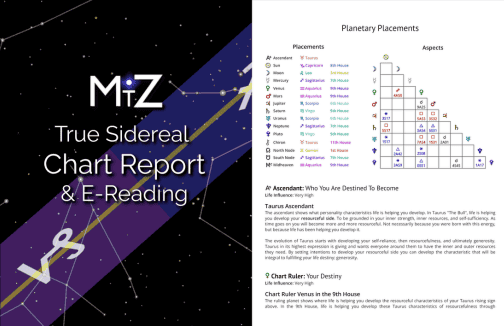
You can learn more about the system and generate your own report here: Mastering the Zodiac. Astrology SA’s subscribers can unlock 50% off MTZ’s premium deep-dive reports and chart readings.
How to use your report for career decisions
If you do generate a chart, here is how I would approach it.
- Start with your Midheaven and 10th house. What does your chart say about the public role you are built for? Does it match your current title?
- Check your Saturn. Where is it by sign and house? What is it asking you to master, and have you done that work?
- Note where Jupiter is heading. Your next window of expansion is usually visible a year or two ahead.
- Read the year, not just the chart. Use the yearly view to decide when to ask for the raise, launch the project or leave the job.
- Hold it lightly. Astrology describes timing and tendency. Your choices still matter. The chart tells you what the weather is; you decide whether to sail.

An empowering way to close
Career anxiety often comes from a simple assumption: that we are late, behind, or in the wrong place. A well-read chart tends to dissolve that. It says: this is the season you are in, this is what it is for, and this is when the next one begins.
If 2026 has felt like a year of dismantling and rebuilding your relationship to work, that is not random. It is a conversation between the sky and your chart. The question is whether you are listening to the right chart.
Whether you are a seasoned reader curious about the sidereal view, or someone encountering your birth chart for the first time, MTZ is worth exploring. Enter your birth details, see what comes up, and let your own sky do the talking.
Consider deepening your understanding with structured resources that help you read the sky in a way that feels personal and empowering. For more insight into how astrology can guide your growth and clarity, subscribe to the Astrology SA monthly newsletter.
Frequently Asked Questions
1. How does a birth chart show the best timing for a career change? A birth chart shows your natal strengths, while transits, progressions and annual cycles show when different areas of your chart are activated. Astrologers look at the Midheaven, the 10th, 6th and 2nd houses, and the movement of Saturn and Jupiter to identify windows for change.
2. What is the difference between sidereal and tropical astrology? Tropical astrology measures the zodiac from the spring equinox (the seasons). Sidereal astrology measures it against the fixed stars. Because of precession, the two have drifted about 24 degrees apart, so many people have different sign placements in each system.
3. What is a true sidereal birth chart? A true sidereal birth chart places your planets and angles in the zodiac as anchored to the stars rather than the seasons. Mastering the Zodiac offers a true sidereal report based on your birth details.
4. What does Saturn do in a career chart? Saturn represents responsibility, discipline and long-term mastery. Its cycles, including the Saturn return in your late twenties and late fifties, often coincide with major professional reassessments.
5. What does Saturn and Neptune in Aries mean for work in 2026? In the tropical zodiac, Saturn and Neptune meeting at 0° Aries in early 2026 symbolizes structures being tested while ideals dissolve. Many people reassess what they are building and whether it still reflects their values. How it plays out depends on the house Aries occupies in your own chart.
6. Is a yearly astrology report worth it? A yearly report focuses on what is being activated in your chart over the year, which makes it more useful for timing decisions than a general natal chart alone. MTZ offers a more in-depth yearly report alongside its true sidereal report.
7. How much does a Mastering the Zodiac report cost? A report is $47.50, and a limited-time 50% discount is available through the Astrology SA partner link. You enter your birth details to generate your report.
8. Can astrology predict career success? Astrology does not guarantee outcomes. It describes tendencies, strengths and timing, which can help you make more informed and intentional career decisions.