
There’s a moment every serious astrology student eventually has. You’ve read your Sun sign a hundred times. You know your Moon, your rising, your Venus placement by heart. And yet, somewhere underneath all that fluency, a quiet question keeps surfacing: does this actually describe me?
If you’ve felt that gap, between the chart you were given and the self you actually experience, you’re not imagining things. And 2026, astrologically speaking, is the year that question deserves a real answer.
The Sky Has Moved. Has Your Chart Kept Up?
Here’s something most horoscope apps will never tell you: the zodiac you grew up with isn’t actually tracking the sky above you. It’s tracking the seasons.
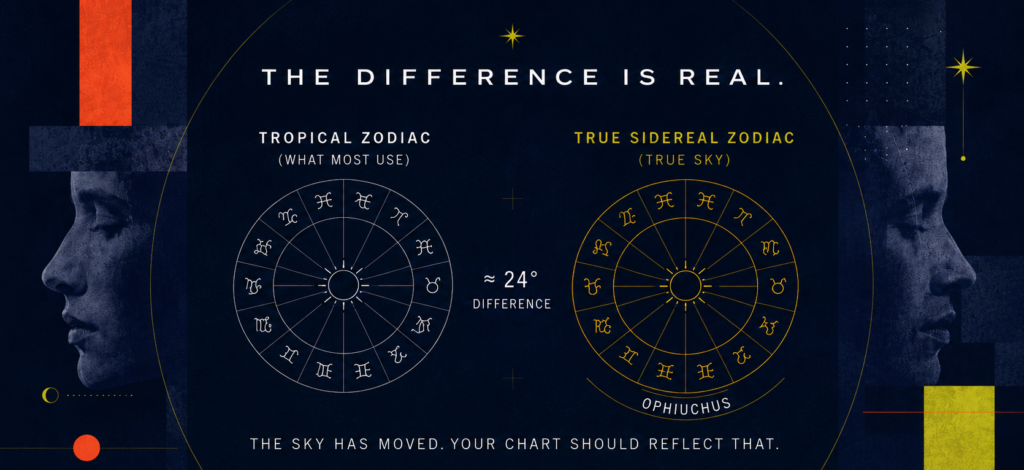
About 2,000 years ago, when tropical astrology’s framework was set, the constellations lined up neatly with the equinoxes. The Sun sat in Aries at the spring equinox, and the calendar-based zodiac was born from that alignment. But the Earth wobbles slowly on its axis, a phenomenon astronomers call the precession of the equinoxes, and over two millennia, that wobble has quietly dragged the visible constellations out of sync with the tropical calendar. Today, when the spring equinox arrives, the Sun is actually sitting in Pisces, not Aries. The gap between where tropical astrology says the planets are and where they actually appear against the backdrop of stars is now nearly a full sign wide.
You can verify this yourself with any star-tracking app on a clear night. Point it at the sky, and you’ll see planets sitting in constellations your horoscope never mentions.
This is the foundation of true sidereal astrology, sometimes called 13-sign astrology, a system built by astrologer Athen Chimenti and his team at Mastering the Zodiac (MTZ). Rather than working from a fixed calendar, true sidereal astrology maps your planets against the constellations as they actually appeared in the sky the moment you were born. It’s the same sky your ancestors studied for thousands of years, long before calendars simplified the heavens into twelve tidy, equal slices.
Meet the 13th Sign You Were Never Taught
One of the most striking differences you’ll notice in a true sidereal chart is the presence of a sign most Western astrologers never mention: Ophiuchus, the serpent bearer.
Ophiuchus sits on the ecliptic, the actual path the planets trace through the sky, between Scorpio and Sagittarius, and the Sun passes through it roughly from December 7th to 18th each year, according to MTZ’s Midpoint Method for calculating sign boundaries. Because Ophiuchus shares its stretch of sky with the deeper, transformational territory of Scorpio, both signs carry themes of intensity, depth, and rebirth. That’s also why true sidereal astrology still works with the traditional 12-house system: Ophiuchus and Scorpio occupy the same eighth-house region of the sky rather than requiring a thirteenth house of their own.
What’s reassuring, if you’re new to this, is that true sidereal astrology doesn’t ask you to relearn everything. The core interpretations of each sign, what Aries energy feels like, what Cancer needs, what Capricorn is working toward, remain essentially the same as mainstream Western astrology. What shifts is which sign your planets are actually placed in, and, in some cases, dates that run noticeably longer or shorter than the tropical calendar suggests. Some signs, like Cancer, may last as briefly as 18 days in the sky, while others, like Virgo, can stretch past 50, a reflection of the genuinely uneven size of the constellations themselves, not an arbitrary rule.
There’s one more subtle but meaningful reinterpretation worth knowing before you look at your own chart: the angles. Where much of traditional astrology treats your ascendant as a fixed “mask” or persona you were born wearing, MTZ interprets the sidereal ascendant, and the Midheaven, as a portrait of who you are becoming. Not a fixed personality trait, but a direction life is quietly developing in you over time. It’s a small shift in framing that changes how you read your entire chart, turning it from a static snapshot into something closer to a living, evolving map.

Your Chart Is a Photograph. Your Year Is a Film.
Once you’ve seen your true placements, the natural next question is: okay, now what?
This is where the distinction between a natal chart and a transit forecast becomes essential, and where MTZ offers two genuinely different tools rather than one report wearing two hats.
The True Sidereal Chart Report is a comprehensive, twelve-page deep dive into your natal chart: your true planetary positions, your ascendant and chart ruler, your Midheaven, Chiron, and your all-important lunar nodes, along with the aspects connecting them. It comes paired with a two-page generated reading and includes all thirteen signs, your elemental and modal composition, and easy-reference tables and aspectarian charts. Think of it as a detailed photograph of who you are at the soul level, the architecture underneath the personality.
The Yearly Transit Report, by contrast, is closer to a film than a photo. This is a substantial document, well over 100 pages, mapping the major transits, retrogrades, and lunar phases moving through your personal chart over the next twelve months, broken down into yearly themes, monthly arcs, weekly rhythms, and day-by-day detail. It includes the full eclipse calendar, major and minor planetary aspects, and, again, interpretation through all thirteen true sidereal signs. If the natal report tells you who you are, the yearly report tells you what this particular year is asking of you, and when.
Together, they answer two different but equally important questions: what is my nature, and what is this season of my life actually for.

Why This Particular Moment Matters
If you’ve felt 2025 and the start of 2026 as unusually intense, you’re not alone, and the sky itself is a fairly good explanation why.
Pluto has now settled fully into Aquarius, beginning a transformation of collective systems, technology, and power structures that will unfold for roughly the next two decades. Layered on top of that, both Saturn and Neptune are moving into Aries in early 2026, Neptune in late January, Saturn in mid-February, meeting in a rare conjunction that astrologers describe as a once-in-a-generation reset of identity, courage, and direction. By midyear, Jupiter shifts into expressive, confidence-building Leo, and the lunar nodes themselves change axis in late July, moving into Leo and Aquarius and opening an entirely new eclipse cycle centered on the tension between individual self-expression and collective transformation.
It’s a lot. And it’s exactly the kind of year where knowing your actual chart, not an approximation, not a calendar-based stand-in, but the true positions of your planets against the real sky, stops being a nice-to-have and becomes genuinely useful. When Saturn and Neptune collide in Aries, the house that transit lands in for you personally matters enormously. If your sidereal placements shift that house assignment even slightly compared to your tropical chart, your entire read on the year changes with it.
This is also, not coincidentally, a year when relationship astrology and composite work are trending hard, with more people looking at synastry, node placements, and karmic timing than in recent memory. And here again, the node-centered approach MTZ takes is worth understanding: rather than treating the ascendant as the most important point in the chart, MTZ recommends starting with your North and South Nodes, the karmic axis that shows both what you’re building toward in this life and what you’re learning to release. With the nodes themselves changing signs this year, that axis is more active, and more worth understanding, than it has been in over a decade.
Seeing It for Yourself
None of this needs to stay theoretical. You can actually see the difference between your tropical chart and your true sidereal one in a matter of minutes.
MTZ offers a free true sidereal mini-report that calculates your Sun, Moon, and rising sign based on the constellations as they genuinely appeared at your birth, along with a personalized sky view showing exactly how the heavens were arranged that day. For most people, this alone is a small revelation, a placement they didn’t expect, a sign that suddenly explains a lifelong feeling of not quite fitting the description they’d always been given.
Exclusive Partner Perks:
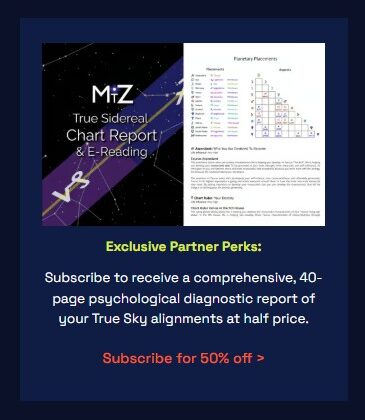
If that free look resonates, and for most people who go looking, it does, the full True Sidereal Chart Report and Yearly Transit Report are where the real depth lives. Right now, through this link, Astrology SA readers can access both reports at 50% off, bringing each down to $47.50. Enter your birth details, generate your chart, and within about ten to fifteen minutes, your personalized report, built from the sky as it actually looked the day you were born, lands in your inbox.
An Underused Tool for a Turning-Point Year
Astrology has never needed to be either mainstream or fringe; it’s always been most useful as a mirror held up carefully, with precision. True sidereal astrology has existed for as long as people have looked at constellations rather than calendars, but it remains genuinely underused, even among astrologers who’ve been reading charts for years. That’s part of what makes it worth your attention right now, in a year already defined by planets changing signs and old structures loosening their grip.
You don’t need to abandon what you already know about astrology to explore this. You don’t need to relearn twelve signs of meaning from scratch. You simply need a more accurate map of where the planets actually were, and, ideally, a clear read on what they’re doing this year, while the sky itself is in the middle of one of its bigger shifts in decades.
Start with your free true sidereal placements. See what shifts. From there, the chart report and the yearly forecast are simply the next, more detailed layer of the same question every good astrology practice is really asking: who are you, underneath the story you were told, and where is this year quietly taking you?
Frequently Asked Questions
What is true sidereal astrology, and how is it different from tropical astrology? True sidereal astrology (also called 13-sign astrology) calculates your planetary placements based on the actual, visible positions of the constellations at the time of your birth. Tropical astrology, the mainstream Western system, instead uses a fixed seasonal calendar that no longer matches the real sky due to the slow precession of the equinoxes.
Why does true sidereal astrology include 13 signs instead of 12? Because the true sidereal zodiac follows the real constellations along the ecliptic, it naturally includes Ophiuchus, the constellation between Scorpio and Sagittarius that the Sun passes through roughly December 7th through 18th. Mainstream astrology omits Ophiuchus because it was built on a symbolic 12-sign calendar rather than the physical sky.
Will my sign change if I look at my true sidereal chart? For most people, yes, often by one full sign, since the sky has shifted nearly 30 degrees since the tropical zodiac was established roughly 2,000 years ago. Your interpretations stay familiar (a sidereal Scorpio Moon still feels like a Scorpio Moon), but the sign itself may be different from what you’re used to.
Do I need to already understand astrology to use a sidereal chart report? No. The True Sidereal Chart Report is written to be accessible whether you’re brand new to astrology or have been reading charts for years, and it uses the same core sign and planet interpretations as mainstream Western astrology. The difference is in accurate placement, not vocabulary.
What’s the difference between a natal chart report and a yearly transit report? A natal chart report maps your permanent placements: your personality, strengths, and life patterns as shown by your planets at birth. A yearly transit report forecasts how current planetary movements interact with your natal chart over the coming 12 months, offering monthly, weekly, and even daily insight into timing.
Why does Mastering the Zodiac focus so much on the lunar nodes? MTZ considers the North and South Nodes the most important karmic axis in the chart, showing what you’re building toward in this lifetime (North Node) and what you’re learning to balance or release (South Node). With the nodes shifting into new signs in 2026, this axis is especially active right now.
Can I still get insights if I don’t know my exact birth time? Yes. Without a birth time, you’ll still get accurate planet signs and aspects, roughly two-thirds of a full chart’s insight, though house placements (which show specific life areas like career or relationships) won’t be available.
How long does it take to receive a Mastering the Zodiac report? After entering your birth details, both the True Sidereal Chart Report and the Yearly Transit Report typically arrive by email within 10 to 15 minutes.